|
|
 You can see more information by clicking on the tabs above
Dandelion - Taraxacum Officinale overview
|
|
| |
|

Dandelion - Taraxacum Officinale
|
Taraxacum Officinale
Family Weber Compositae
Taraxacum officinale, which means the “Official Remedy for Disorders”
otherwise known as the common dandelion
[1] . It is one most widely-respected plants, featuring in the Pharmacopoeias of Hungary, Poland, Switzerland and the Soviet Union as well as the the U.S. National Formulatory. Dandelion is one of the top 6 herbs in the Chinese herbal medicine chest and has been rated one of the top 4 green vegetables in overall nutritional value[2].
Dandelion is corrupted French for 'dents de lion' (tooth of the lion), referring to the jagged edge of the leaf. It is also known as bitterwort, wild endive, Irish daisy and some other names as well. It is “universally considered a noxious weed that “destroys” lawns”
[3] - perhaps it should be rephrased as “lawns should be considered noxious environments because they encourage mowing which destroys valuable plants like Dandelions”.
The leaf of the Dandelion is used for salads, soups and stir frys, as well as in herbal teas. Is considered a high nutrient food and is primarily used to stimulate the digestion.
The root is used for medicinal purposes and Dandelion coffee is a well known substitute for caffeine-rich coffee.
Dandelion acts as a tonic to the whole system and destroys acids in the blood. it is recognised as a great blood builder and Purifier.
Containing organic sodium it is very good for Anaemia caused by a nutritive salts deficiency. It is also effective as a Liver Cleanser.
Some features of the dandelion:[4]
- The dandelion is the only flower that represents the 3 celestial bodies of the sun, moon and stars. The yellow flower resembles the sun, the puff ball resembles the moon and the dispersing seeds resemble the stars.
- The dandelion flower opens to greet the morning and closes in the evening to go to sleep.
- Every part of the dandelion is useful: root, leaves, flower. It can be used for food, medicine and dye for coloring.
- Up until the 1800s people would pull grass out of their lawns to make room for dandelions and other useful “weeds” like chickweed, malva, and chamomile.
- Dandelions have one of the longest flowering seasons of any plant.
- Dandelion seeds are often transported away by a gust of wind and they travel like tiny parachutes. Seeds are often carried as many as 5 miles from their origin!
- Animals such as birds, insects and butterflies consume nectar or seed of dandelion.
- Dandelion flowers do not need to be pollinated to form seed.
- Dandelion can be used in the production of wine and root beer. Root of dandelion can be used as a substitute for coffee.
- Dandelions have sunk their roots deep into history. They were well known to ancient Egyptians, Greeks and Romans, and have been used in Chinese traditional medicine for over a thousand years.
- Dandelion is used in folk medicine to treat infections and liver disorders. Tea made of dandelion act as diuretic.
- If you mow dandelions, they’ll grow shorter stalks to spite you.
- Dandelions are, quite possibly, the most successful plants that exist, masters of survival worldwide.
Dandelion - Taraxacum Officinale uses
|
|
| |
|
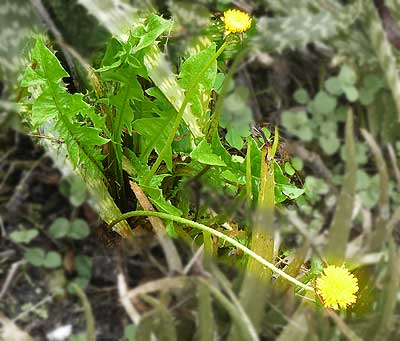
Young plant in the aloe garden
|
Dandelion works well with these conditions:
[5] [6] [7] [8] :
| |
- Anaemia
- Blood Pressure (Low)
- Blood Purifier
- Gall Bladder
- Hypoglycaemia
- Kidneys
- Skin Problems
- Water Retention
|
Dandelion is also used for children and babies in a tea as a gentle laxative.
These other Conditions also respond well to Dandelion:
| |
Acne
Age Spots
Appetite (improves)
Bladder
Boils
Bronchitis
Cancer
Cleansing
Constipation
Cramps
Diabetes
|
|
Digestive Disorders
Eczema
Endurance
Energy
fatigue
Fever
Flue
Fractures
Gall Stones
Gout
Heartburn
|
|
Haemorrhage
Insomnia
Jaundice
Liver
Pancreas
Psoriasis
Senility
Spleen
Tonsillitis
Vitality
Wounds
|
Contra-indications: It should not be used medicinally by pregnant or breast feeding women. May interfere with anti-diabetic drug, antihypertensives, diuretics and quinolone antibiotics.
Dandelion - Taraxacum Officinale actions
|
|
| |
|

a mature Dandelion plant growing in sandstone!!
|
Dandelion has these actions
[5] [6] [7] [8]
Major medicinal actions of Dandelion - Taraxacum Officinale[9]

Tincture
|
|
- analgesic
- anthelmintic
- antiaging
- antibacterial
- anticancer
- antidepressant
- antidiabetic
- antihypertensive
- antiinflammatory
- antileukemic
- antimicrobial
- antioxidant
- antipyretic
- antirheumatic
- antiseptic
|
- antispasmodic
- antitumor
- antiulcerogenic
- antiviral
- ascorbic-acid
- astringent
- beta-carotene
- cholagogue
- choleretic
- choline
- cryptoxanthin
- demulcent
- detoxicant
- diuretic
- emetic
|
- emollient
- expectorant
- febrifuge
- fungicidal
- hypotensive
- laxative
- levulose
- linoleic-acid
- mucilage
- niacin
- riboflavin
- saponin
- sedative
- thiamin
- vulnerary
|
That is a lot of health-maintaining activity in just one plant. However there is more - here are other actions attributed to the constituents found in Dandelion - Taraxacum Officinale. Of course not all of these are considered major actions of Dandelion - Taraxacum Officinale, however the list does demonstrate just how comprehensive Dandelion - Taraxacum Officinale’s health maintaining abilities are.
Other actions of Dandelion - Taraxacum Officinale[9]
Dandelion - Taraxacum Officinale constituents
|
|
| |
|

a young Dandelion plant
|
Constituents
These main ingredients are found in Dandelions:
- Inulin, which converts to fructose in the presence of cold or hydrochloric acid in the stomach. Fructose forms glycogen in the liver without requiring insulin, resulting in a slower blood sugar rise, which makes it good for diabetics and hypoglycaemic.
- Pectin, which is antidiarrheal and also forms ionic complexes with metal ions, which probably contributes to dandelion’s reputation as a blood and gastrointestinal detoxifying herb. Pectin can also lower cholesterol and, combined with Vitamin C, can lower it even more. Dandelion is a good source of both Pectin and Vitamin C.
- Coumestrol, an estrogen mimic and galactagogue which possibly is responsible, at least in part, for stimulating milk flow.
- Apigenin and Luteolin, two flavonoid glycosides which have been demonstrated to have diuretic, antispasmodic, antioxidant and liver protecting actions and properties, and also to strengthen the heart and blood vessels. They also have antibacterial and antihypoglycemic properties, and, as estrogen mimics, may also stimulate milk production (galactagogue);
- Gallic Acid, which is antidiarrheal and antibacterial.
- Linoleic and Linolenic Acid, which are essential fatty acids required by the body to produce prostaglandin which regulate blood pressure and such body processes as immune responses which suppress inflammation. These fatty acids can lower chronic inflammation, such as proliferative arthritis, regulate blood pressure and the menstrual cycle.
- Several Sesquiterpene compounds which are what make dandelions bitter (a key indicator of many tonics
[10] ) and are highly antifungal.
- Taraxasterol, which may contribute to liver and gall bladder health.
There are also essential oils, levulin, choline, taraxacin, mucin, saponins, resin, fatty acids, sugars, gum, protein (16.5%)
Vitamins
Dandelion contains vitamins A (the third richest source of Vitamin A of all foods, after cod-liver oil and beef liver! [2]), B1, B2, B3, C, D and E.
Minerals
Boron, Calcium, Chromium, Copper, Cobalt, Iron, Magnesium, Manganese, Molybdenum, Phosphorus, Potassium, Sodium, Selenium, Silicon and Zinc.
Complete list of active constituents found in Dandelion - Taraxacum Officinale[9]
Tincture
|
|
- ascorbic-acid ( Leaf 350 - 2,430 ppm )
- beta-amyrin
- beta-carotene ( Root 84 ppm )
- beta-sitosterol
- boron ( Leaf 4 - 125 ppm )
- caffeic-acid
- calcium ( Leaf 1,870 - 13,000 ppm )
- chlorine ( Leaf 5,300 - 22,000 ppm )
- choline
- chromium ( Leaf 11 - 50 ppm )
- cobalt ( Root 80 ppm )
- copper ( Leaf 9 - 12 ppm )
- coumestrol
- cryptoxanthin
- cycloartenol
- faradiol
- fiber ( Leaf 4,400 - 111,110 ppm )
- fructose
- glucose ( Root 5,000 ppm )
- glutamic-acid
- glycerol
- inulin ( Root 250,000 - 400,000 ppm )
- iodine
- iron ( Leaf 31 - 5,000 ppm )
- lecithin ( Flower 29,700 ppm )
- levulose
- linoleic-acid
- lutein
- luteolin-7-glucoside
- magnesium ( Leaf 360 - 2,500 ppm )
|
- manganese ( Plant 100 - 130 ppm )
- mannitol
- molybdenum
- mucilage ( Root 85,000 ppm )
- niacin
- nickel
- nicotinic-acid
- oleic-acid
- p-coumaric-acid
- palmitic-acid
- phosphorus ( Leaf 591 - 4,583 ppm )
- potassium ( Leaf 3,970 - 27,569 ppm )
- riboflavin ( Leaf 1 - 18 ppm )
- selenium
- silicon ( Root 47 ppm )
- sodium ( Leaf 760 - 5,278 ppm )
- stigmasterol
- sucrose
- sulfur ( Plant 2,600 - 3,300 ppm )
- tannin
- taraxasterol
- taraxerol
- tartaric-acid
- thiamin ( Leaf 1 - 13 ppm )
- tin ( Root 13 ppm )
- tyrosinase
- violaxanthin
- xanthophyll
- zinc ( Root 13 - 60 ppm )
|
Dandelion - Taraxacum Officinale history
Dandelions are believed to be some of the oldest plants on the planet [11]. They have been found in fossils dating back thirty million years ago in Eurasia. This plant has been consistently used by humans as a food, and as a medicinal plant for diuretic purposes.

Taraxacum Officinale WEBER COMPOSITAE
Dandelion
Although the Dandelion is generally considered to be a ubiquitous weed, it is in fact one of the most useful of European herbs and all parts of the plant can be employed. It is an extremely effective medicinal plant, being possibly the safest and most-active plant diuretic and one of the best herbs known to treat liver complaints. Both the leaves and root have long been eaten as salad material, and in the last century cultivated forms with large leaves have been developed as an autumn and spring vegetable; these usually being blanched in the same way as Endive.
Dandelion roots provide (when dried, chopped and roasted) the best-known coffee substitute, and all parts have been employed in fermented and unfermented beers,wines and tonic drinks. Surprisingly the herb is rarely mentioned by the ancient Greeks and Romans, and it is generally considered that the Arabs promoted its use in the eleventh century.
By the sixteenth century it was well established as an official drug of the apothecaries, who knew it as Herba Taraxacon or Herba Urinaria - the latter term emphasizing its diuretic effect. It was also called Denta Leonis (lion's teeth), after the leaf shape, and from which term the common name is derived via the French dents de lion.
It is still retained in the national pharmacopoeias of Hungary, Poland, the Soviet Union and Switzerland. The Russian Dandelion (T. kok-saghyz Rodin.) was extensively cultivated during the Second World War as a source of rubber, which was extracted from the latex of the roots. Small quantities of a similar latex are found in T. officinale.
Description Variable perennial on taproot, to 30 cm tall. Leaves spatulate, oblong or oblanceolate, entire to runcinate-pinnatifid. Flowers yellow, on hollow scapes, appearing late spring to mid-summer.
Distribution Native to Europe and Asia; introduced elsewhere. On nitrogen-rich soils in any situation to 2000 m altitude.
Cultivation Wild. Propagated from seed sown in spring for use as an autumn salad herb. Blanch by earthing up or placing an inverted flower pot over the plant. Grow as an annual to prevent bitterness developing in the plant.
Constituents Taraxacin, a bitter principle; taraxerin, an acrid resin; taraxerol; taraxasterol; 3:4 dioxycinnamic acid; flavoxanthin; inulin; citric acid; phenyloxyacctic acid; riboflavin; sitosterol; sitosterin; stigmasterol; coumestrol; vitamins B, C and provitamin A.
Uses (fresh or dried roots, leaves and flowers) Diuretic; cholagogue; choleretic; laxative; bitter tonic; stomachic.
An excellent bitter tonic in atonic dyspepsia; a mild laxative in chronic constipation; a cholagogue and choleretic in liver disease (especially jaundice, cholecystitis and the primary stages of cirrhosis), Considered of benefit as an antirheumatic. As a bitter it promotes appetite and aids digestion. A very effective diuretic.
Leaf and root used as a salad; root is a coffee substitute. Flowers used in Dandelion wine, and leaves in Dandelion beer and tonic drinks. The plant is safe to use in large amounts. |
Is it Safe for me to take Dandelion - Taraxacum Officinale Tincture? If you have any concerns or apprehensions please use our free Herbal Tincture enquiry service so that we can make sure that what you want is completely safe for your situation or condition.
We especially encourage you to get in touch if you have any of the following health problems or conditions:
- An enlarged prostate gland
- Are preganant or breast-feeding
- Blood clotting problems
- Cancer
- Diabetes
|
|
- Epilepsy
- Glaucoma
- Heart disease
- High blood pressure
- Immune system problems
|
|
- Liver problems
- Psychiatric problems
- Parkinson's disease
- Stroke
- Thyroid problems
|
You have two options when you purchase Dandelion tincture:
- For external use which you can apply externally to the soles of your feet or topically on an external condition - you can purchase these without a consultation.
- For internal use. If you wish to take it internally because of the potency of these tinctures you need to be sure they will not cause complications with an existing health condition or prescribed drugs you may be taking.

Dandelion tincture
| |
|
If you are in any doubt about the possibility Dandelion tincture causing complications with prescription drugs or a medical condition you may have please get in touch so that we can advise you on the suitability of a particular tincture.
Especially if you are pregnant or breast-feeding.
You can have an online consultation or visit our clinic for a thorough consultation if you wish to purchase our potent tinctures for internal use.
There are fewer concerns when using Dandelion tincture externally and our many years of experience has shown that the tincture is just as effective being applied into the soles of the feet or applied
topically
on external conditions where they will be absorbed into your system.
Our clients who have come for a consultation use the same tincture internally and we recommend they take half an eyedropper (about 1.5ml) of herbal tincture in a small glass of water three times per day for adults and a quarter of an eyedropper in a small glass of water for children.
Dandelion tincture is a potent liquid extract made from organic Dandelion. It is a concentrated way of getting herbal medicine into your body easily especially applying them to the soles of your feet. Once a tincture is prepared, it has an extremely long shelf life. Tinctures should be kept in a cool, dark cupboard to maintain their potency.
If you are on any prescribed medication we strongly advise you to use our free Herbal Tincture enquiry service to make sure that the medication and potent Dandelion tincture are compatible.
| |
|

making medicine for internal use
|
How to Use Dandelion Tincture internally
How do I prepare my Dandelion Tincture?
Just add the recommended dosage - which is usually 1.5ml or one eyedropperfull - to a glass of drinking water or any other cold drink.
Then drink it.
When should I drink my Dandelion Tincture?
For best absorption, consume herbal tinctures 30 minutes or more before meals or drinking other liquids to avoid diluting it while it is in your digestive tract.

How to Use our Tinctures externally

how to apply a tincture to the soles of your feet
| |
|
If you are treating an external condition - such as a skin infection - then simply apply the tincture directly to the site using the eyedropper or a suitable swab.
If you are treating an internal condition then the best way to get the tincture into your body is through the soles of your feet. The skin is a highly absorptive organ and the feet have the reflexology facility which helps get the healing properties of the herbs right to the place inside you where they will do the most good.
If you don't have someone to do it for you, the easiest way we've found is to apply it sitting down. Rest one foot on your other leg's thigh (use a towel to make sure the tincture doesn't drip on your furniture or clothes), squirt a small amount of tincture onto the palm of one hand (about 1.5ml or half an eyedropper), rub it gently into the sole of your foot. In most cases you will find it has been absorbed within 30 seconds or so - you'll know when your foot feels dry. Then do the same to your other foot and the treatment is complete.
Dandelion - Taraxacum Officinale cultivation
| |
|

Dandelion seed head
|
Highly nutritious and known to treat a variety of ailments, dandelion is a great plant to grow in your garden. From heart problems to acne, liver diseases to eye conditions, most people are unaware that this weed has higher amounts of potassium than bananas and more vitamin A than carrots. Dandelion is also reported to have anti-rheumatic capacities. It is also a powerful diuretic with additional laxative properties. Good for hepatic and gallbladder conditions, digestive complaints, as well as general constipation [11].
Dandelion is one of the hardiest around. It can grow most everywhere, regardless of soil conditions, but does best in rich soil with sufficient moisture.

ready for the wind to do the work
| |
|
It is very strong and can do well in hot summers and cold winters, but prefers full sun but also does well in partial shade.
Propagation is by seed - plant the dandelion seeds in early spring in well-drained, fertile soil directly in the garden 1/4 inch deep. Once mature the wind will do the work for you and it is a delight to see the seeds gently parachuting around the area looking for a sheltered spot to lodge and grow.
| |
|
a young Dandelion plant
|
They often find a tiny crack in our sandstone or concrete and will grow in what seems to be a very inhospitable site.
You can harvest the green leaves throughout the growing season, roots are best harvested in autumn - extract the entire root from the ground and avoid breakage.
You can see more information by clicking on the tabs below
middlepath.com.au> Middle Path> Plants> Dandelion - Taraxacum OfficinaleReferences
|
|


