|
|
 You can see more information by clicking on the tabs above
Papaya aka Pawpaw overview
|
|
| |
|

Papaya seed tea works wonders for stomach
problems because of its high natural papain
|
Papaya or Pawpaw cancer cure resurfaces
Carica papaya
Interest in the use of Pawpaw as a “cure” for cancerous conditions is increasing
[1] [2] [3] [4] [5]; Stan's story is just one example.
We believe Pawpaw has been used for a wide variety of therapeutic purposes by a broad cross-section of indigenous populations for many centuries. However conventional medicine, true to form, considers evidence of this usage “anecdotal and inconclusive”. This is in contrast with typical chemotherapy anecdotes
[6] , studies
[7] [8] [9] and quotes
[10] [11] [12] which generally show chemotherapy gives a much poorer performance than is widely known or admitted.
Our experience using Pawpaw therapeutically
Here in Australia the terms Paw Paw and Papaya are used interchangeably; when we speak about the Pawpaw or Papaya that we use for medicinal purposes, we are referring to Carica Papaya not the Paw Paw tree ( Asimina triloba) which is native to North America and also is used as a cancer treatment [13].
Our clients at our Middle Path clinic have noticed that Papaya taken as a tea or tincture works wonders on their bowel movements and have asked us if that is normal. Papaya detoxifies the system and what a better way to do so by cleansing the bowel - the body's main organ of elimination.
We have prescribed Papaya for digestive disorders and clients have reported the bonus of an effortless weight-loss due to more effective nutrient assimilation as well as improved digestive juices.
We have been recommending Papaya tea (or tincture where appropriate §) for obese and overweight people with our Journey to Slimness CD, instantly downloadable MP3 or e-book and the results have been outstanding.
Naturally Paw Paw features in our Take Stress Anxiety and Worry out of having Cancer ebook and is a major component in our C-mix anti-cancer tincture.
 Ancient traditional cancer cure regaining popularity, also very useful for a whole range of internal imbalances and diseases
 Papaya contains Papain which is an enzyme similar to Pepsin which is produced by the stomach. Mixing goats milk and Papaya blended together is a very close resemblance to human breast milk. Papaya has one of the highest enzyme contents of any herb worldwide.
Eating about 4 dry or straight from the plant Papaya seeds with each meal helps people with digestive problems. You can also dry them and use them in a pepper grinder as a spice and grind it over your food. Papaya seed tea works wonders for stomach problems because of its high natural papain.
Papaya tea also helps you to digest protein easily. Use 1 tablespoon of the seeds to one cup of boiling water and let stand for 20 minutes. If you want you can simmer the mixture for a few minutes, this will get more papain out of the the tea.
If you have any gum issues like Pyorrhea then one really great remedy is make up some Papaya tea and leave it overnight then soak gums in the strained tea for 15 minutes. This will get rid of any bacteria and dead tissue that is gathered around the teeth. Papaya eats away any dead tissue but does not destroy healthy good tissue. This same method is used for people who have a formation of tartar on their teeth. As an additional mouthwash you can gargle with liquid chlorophyll - it works wonders.
At Middle Path we use Pawpaw extracts - chiefly tinctures we prepare here at Middle Path from organically-grown plants - for a range of conditions, including cancerous ones. |
|
| |
|

Eating about 4 dry or straight from the plant
Papaya seeds with each meal helps people
with digestive problems
|
|
We also provide dried Pawpaw plant material as a herbal tea through our online webshop for customers around the world. Although we find the tinctures are more palatable and usually they seem to have greater potency, we are constrained by Australian Law from offering these without consultation. We offer an online consultation service based on Trijntje's gift of Medical Intuition for people around the world who are challenged in getting naturopathic advice, guidance or treatment for their situation.
Ailments that we have seen Papaya work wonders on include:
| |
- Allergies
- Cancer - all varieties
- Colitis
- Digestive Disorders
- Dyspepsia
- Gas
|
- Gum Ailments
- Lack of Stomach (HCl) Acid
- Liver
- Mucous Membranes
- Obesity
- Parasites
|
- Pyorrhea
- Stomach Weakness
- Tumors
- Weight Loss
- Worms
- Wounds
|
Another summary of the Healing Properties of Papaya
[14]
- Increases quality of proteins in whole organism.
- Revitalize the human body and maintain energy and vitality.
- Encourages the renewal of muscle tissue.
- Supports cardiovascular system.
- Boosts up the immune system.
- Helps with the digestive system, by breaking down the proteins and supporting production of digestive enzymes.
- Papaya can be use also externally as a treatment for skin wounds that dont heal quickly, for this you can use papaya peel or ointments made out of papaya.
- Prevents the cataract formation.
- Due to high vitamin A, it lowers the risk of emphysema in smokers and passive smokers.
- Alleviates inflammation.
- Helps with the nausea and constipation.
- Can benefit people suffering colon cancer and other forms of cancers and aliments of cardiovascular and gastrointestinal systems.
Contra-indications: Papaya may cause severe allergic reactions and is therefore contraindicated in sensitive people. Papaya latex can be a severe irritant and vesicant on skin. Papaya juice and papaya seeds are unlikely to cause adverse effects when taken orally; however, papaya leaves at high doses may cause stomach irritation
[15] .
Papaya aka Pawpaw actions
|
|

Major medicinal actions of Papaya aka Pawpaw[16]

Pawpaw Tincture
|
|
- analgesic
- antibacterial
- anticancer
- antidepressant
- antidiabetic
- antihypertensive
- antiinflammatory
- antileukemic
- antimalarial
- antioxidant
- antipruritic
- antipyretic
- antirheumatic
|
- antiseptic
- antispasmodic
- antitumor
- antiulcerogenic
- antiviral
- aphrodisiac
- astringent
- cholagogue
- choleretic
- cosmetic
- demulcent
- detoxicant
- diaphoretic
|
- diuretic
- emetic
- expectorant
- fungicidal
- hypotensive
- laxative
- sedative
- stimulant
- vulnerary
|
That is a lot of health-maintaining activity in just one plant. However there is more - here are other actions attributed to the constituents found in Papaya aka Pawpaw. Of course not all of these are considered major actions of Papaya aka Pawpaw, however the list does demonstrate just how comprehensive Papaya aka Pawpaw’s health maintaining abilities are.
Other actions of Papaya aka Pawpaw[16]
Papaya aka Pawpaw constituents
|
|

Active constituents found in Papaya aka Pawpaw [16]
Tincture
|
|
- alanine ( Fruit 523 - 5,331 ppm )
- arginine ( Fruit 240 - 2,336 ppm )
- ascorbic-acid ( Fruit 76 - 893 ppm )
- asimicin
- aspartic-acid ( Fruit 424 - 5,167 ppm )
- beta-carotene ( Fruit 0.4 - 2.5 ppm )
- butyric-acid ( Fruit 0.001 ppm )
- caffeic-acid
- calcium ( Fruit 530 - 3,248 ppm )
- citronellol ( Fruit 0.024 ppm )
- coreximine
- cyanidin
- decanoic-acid ( Fruit 0.01 - 0.662 ppm )
- dodecanoic-acid ( Fruit 0.012 - 0.135 ppm )
- ethyl-acetate ( Fruit 0.008 - 0.143 ppm )
- fiber ( Fruit 14,000 - 150,000 ppm )
- fructose ( Fruit 13,000 - 119,658 ppm )
- geraniol ( Fruit 1.305 ppm )
- glucose ( Fruit 18,000 - 170,940 ppm )
- glutamic-acid ( Fruit 622 - 7,332 ppm )
- glycine ( Fruit 389 - 3,501 ppm )
- hexanoic-acid ( Fruit 0.001 ppm )
- histidine ( Fruit 124 - 1,336 ppm )
- hydroxyproline ( Fruit 70 - 836 ppm )
- iron ( Fruit 68 - 308 ppm )
- isocorydine
- isoleucine ( Fruit 373 - 4,166 ppm )
- leucine ( Fruit 466 - 5,002 ppm )
- leucocyanidin
- limonene ( Fruit 0.027 - 0.548 ppm )
- linoleic-acid ( Fruit 480 - 6,018 ppm )
- liriodenine
- lysine ( Fruit 339 - 3,831 ppm )
- magnesium ( Fruit 1,090 - 5,128 ppm )
- manganese ( Fruit 25 - 111 ppm )
- methionine ( Fruit 70 - 836 ppm )
- myristic-acid ( Fruit 306 - 4,956 ppm )
- octanoic-acid ( Fruit 0.001 ppm )
- oleic-acid ( Fruit 1,392 - 24,780 ppm )
- palmitic-acid ( Fruit 1,080 - 14,396 ppm )
- phenylalanine ( Fruit 294 - 3,001 ppm )
- phosphorus ( Fruit 420 - 2,265 ppm )
- potassium ( Fruit 3,140 - 15,726 ppm )
- quercetin
- quercetin-3'-glucoside
- serine ( Fruit 354 - 3,666 ppm )
- stearic-acid ( Fruit 102 - 2,124 ppm )
- sucrose ( Fruit 60,000 - 545,000 ppm )
- sulfur ( Fruit 620 - 3,333 ppm )
- threonine ( Fruit 254 - 2,812 ppm )
- toluene ( Fruit 0.001 - 0.024 ppm )
- tryptophan ( Fruit 35 - 536 ppm )
- tyrosine ( Fruit 140 - 1,501 ppm )
- valine ( Fruit 334 - 3,661 ppm )
- zinc ( Fruit 9 - 38 ppm )
|
| |
|

Papaya aka Pawpaw tea
|
Why choose a Herbal Tea?
Plants produce a vast range of substances -
phyto-chemical s - which are very beneficial in restoring and maintaining health in we humans without side-effects. We believe that they are perfectly suited to preventative and curative health care because they are natural and harmonious to our bodies.
If you do not have fresh Papaya aka Pawpaw nearby or are not confident you can identify Papaya aka Pawpaw then dried material is the next best way to obtain their beneficial influence.
How long will Papaya aka Pawpaw tea keep it's potency?
Stored properly - in an air-tight glass container away from direct sunlight - Papaya aka Pawpaw tea will keep for up to 18 months without losing it's potency. If you are dealing with the onset of a severe condition we suggest it may be worth purchasing fresh material to have complete confidence in its healing potency.
When should I drink my Tea?
For best absorption, consume herbal teas 30 minutes or more before meals or drinking other liquids to avoid diluting it while it is in your digestive tract.
Caring for your Papaya aka Pawpaw herbal tea
If you don't plan on using the tea immediately, it's best to keep it unopened and away from direct sunlight (in a closed cupboard or drawer). Exposed to the air it may absorb moisture and humidity, so if they are opened, reseal them tightly, or (preferably) put it in a glass jars with a tight-fitting lid (avoid metal containers).
Most will never require refrigeration or freezing - just keep them at average room temperature (70-80 degrees). Generally, the "shelf-life" for optimum freshness will be about a year if stored properly.
If you live in a warm, high humidity area, it may be impossible to keep moisture out of regularly opened and closed glass containers, and the plants may become mouldy. If this happens, discard them and purchase fresh ones. To prevent mould, try storing them in paper lunch bags so they can “breathe” (although this will reduce the shelf-life significantly).
Making an Infusion

pour a cup after it has infused
| |
|
Preparing an infusion is just like making a cup of tea but allowing more time for the water to absorb the Papaya aka Pawpaw essence.
Pour boiling water over the tea (use a glass, stainless steel or ceramic vessel), cover it and allow to soak/steep for 20 minutes or so. Stirring it a few times while steeping is helpful - and is an ideal opportunity to focus your mind on the benefits it will bring to you.
Generally use 1 teaspoon of dried Papaya aka Pawpaw in a 250ml cup of water is sufficient. The standard dosage is one teacup (250ml), two or three times daily.
For convenience, your entire day's dosage can be prepared at night (2-3 cups at one time) and left overnight and then refrigerated for use throughout the day. You can drink it cold or heat it if you want it warm.
Making a Decoction
Because some tea (with bark, stems or roots in them) contains tough, woody material, a decoction is the recommended method for making your medicine.
Instead of just soaking it in hot water, the plant material is boiled for a longer period of time to soften the thicker woody pieces and release its active constituents.
Use a ceramic, glass or enamel pot with a snug fitting lid, if you don't have one then a stainless steel pot is good but definitely not aluminium or teflon.
Add the amount of herb needed (1 teaspoon per 250ml of water) to the proper amount of cold water in the pot depending on how many doses you wish to prepare.
Turn the heat to medium high and bring to a vigorous boil then put the lid on the pot and reduce the heat to maintain a gentle but cheerful simmer for 20 minutes.
If you can see steam escaping or smell the aroma of the herb, your lid is not tight enough and valuable essential oils may be escaping.
After 20 minutes, remove from heat and cool slightly, for maximum potency we encourage you to let it stand overnight.
Strain the mixture through a tea strainer into a wide-necked bottle, jug or cup, making sure to press on the material in the strainer with a spoon or similar to get as much of the liquid/decoction out of the material as possible.
Standard dosages for decoction are generally one-half to one cup, two or three times daily.
A day's dosage can be prepared the prior evening (2-3 cups at one time), allowed to continue to soak while it cools overnight to ensure maximum potency and refrigerated until ready to use throughout the next day.
Papaya aka Pawpaw tincture
|
|
Is it Safe for me to take Papaya aka Pawpaw Tincture? If you have any concerns or apprehensions please use our free Herbal Tincture enquiry service so that we can make sure that what you want is completely safe for your situation or condition.
We especially encourage you to get in touch if you have any of the following health problems or conditions:
- An enlarged prostate gland
- Are preganant or breast-feeding
- Blood clotting problems
- Cancer
- Diabetes
|
|
- Epilepsy
- Glaucoma
- Heart disease
- High blood pressure
- Immune system problems
|
|
- Liver problems
- Psychiatric problems
- Parkinson's disease
- Stroke
- Thyroid problems
|
You have two options when you purchase Papaya aka Pawpaw tincture:
- For external use which you can apply externally to the soles of your feet or topically on an external condition - you can purchase these without a consultation.
- For internal use. If you wish to take it internally because of the potency of these tinctures you need to be sure they will not cause complications with an existing health condition or prescribed drugs you may be taking.

Papaya aka Pawpaw tincture
| |
|
If you are in any doubt about the possibility Papaya aka Pawpaw tincture causing complications with prescription drugs or a medical condition you may have please get in touch so that we can advise you on the suitability of a particular tincture.
Especially if you are pregnant or breast-feeding.
You can have an online consultation or visit our clinic for a thorough consultation if you wish to purchase our potent tinctures for internal use.
There are fewer concerns when using Papaya aka Pawpaw tincture externally and our many years of experience has shown that the tincture is just as effective being applied into the soles of the feet or applied
topically
on external conditions where they will be absorbed into your system.
Our clients who have come for a consultation use the same tincture internally and we recommend they take half an eyedropper (about 1.5ml) of herbal tincture in a small glass of water three times per day for adults and a quarter of an eyedropper in a small glass of water for children.
Papaya aka Pawpaw tincture is a potent liquid extract made from organic Papaya aka Pawpaw. It is a concentrated way of getting herbal medicine into your body easily especially applying them to the soles of your feet. Once a tincture is prepared, it has an extremely long shelf life. Tinctures should be kept in a cool, dark cupboard to maintain their potency.
If you are on any prescribed medication we strongly advise you to use our free Herbal Tincture enquiry service to make sure that the medication and potent Papaya aka Pawpaw tincture are compatible.
| |
|

making medicine for internal use
|
How to Use Papaya aka Pawpaw Tincture internally
How do I prepare my Papaya aka Pawpaw Tincture?
Just add the recommended dosage - which is usually 1.5ml or one eyedropperfull - to a glass of drinking water or any other cold drink.
Then drink it.
When should I drink my Papaya aka Pawpaw Tincture?
For best absorption, consume herbal tinctures 30 minutes or more before meals or drinking other liquids to avoid diluting it while it is in your digestive tract.

How to Use our Tinctures externally

how to apply a tincture to the soles of your feet
| |
|
If you are treating an external condition - such as a skin infection - then simply apply the tincture directly to the site using the eyedropper or a suitable swab.
If you are treating an internal condition then the best way to get the tincture into your body is through the soles of your feet. The skin is a highly absorptive organ and the feet have the reflexology facility which helps get the healing properties of the herbs right to the place inside you where they will do the most good.
If you don't have someone to do it for you, the easiest way we've found is to apply it sitting down. Rest one foot on your other leg's thigh (use a towel to make sure the tincture doesn't drip on your furniture or clothes), squirt a small amount of tincture onto the palm of one hand (about 1.5ml or half an eyedropper), rub it gently into the sole of your foot. In most cases you will find it has been absorbed within 30 seconds or so - you'll know when your foot feels dry. Then do the same to your other foot and the treatment is complete.
Papaya aka Pawpaw history
| |
|

abundant harvest maturing on a pawpaw
|
It is native to the tropics of the Americas, perhaps from southern Mexico and neighbouring Central America. It was first cultivated in Mexico several centuries before the emergence of the Mesoamerican classical civilizations
[17] .
One of first recorded historical references to the pawpaw dates back to Hernando de Soto's expedition of the Southeastern North American continent, in 1540. He wrote of Native American's cultivating the pawpaw and later introduced it to the Europeans.
[18]
In 1736, botanist John Bartram sent some pawpaw specimens back to England. In 1776 his son William wrote that he found pawpaw trees growing on the Alatamaha River in Georgia and in east Florida, which he described as, 'Annona incarna,' the name later was updated by modern taxonomists. “The fruit the size of a small cucumber ...containing a yellow pulp of the consistence of a hard custard, and a very delicious, wholesome food.”
Not much was done with pawpaws during the 1800's, but after the turn of this century, interest swelled. And during the great depression, many people supplemented meager diets with the pawpaw. But after World War II, imported fruit became easily obtainable and interest in pawpaws waned in the US.
Papaya aka Pawpaw cultivation
| |
|

flowers on a male plant
|
Growing a Paw Paw
[19]
These trees love the frost-free heat of the tropics and subtropics. Cold and frosty areas result in poor fruit set and death of the tree.
For a successful crop you’ll need to grow both male and female trees or make sure you have a bisexual tree. It’s impossible to tell the sex of a plant until the tree starts to flower, so plant multiple seeds.

flowers on a female plant
| |
|
When flowering commences at about 4-8 months, identify and cut the male trees off at ground level, leaving one female tree.
How do you tell a male from a female tree?
The males typically grow clusters of flowers on long stalks. The females usually produce shorter stalks with individual flowers. Fruit develop sooner in hotter areas, but expect your first harvest 12 to 18 months after planting the seeds.
Papaya aka Pawpaw other people's experiences
Here is an “anecdote” we have been privileged to have documented by a first party: it illustrates what an individual can do when they take responsibility for their own health and life.
An article which appeared in the Gold Coast Bulletin by Frank Hampson

an abundant pawpaw (papaya)
harvest matures
|
|
|
An American discovery that paw paw leaves may cure cancer is old news for a Gold Coast bookie who was extolling the plant's virtues 14 years ago.
Stan Sheldon, then 70, told the bulletin in May 1978 how he beat cancer by following an old Aboriginal recipe and drinking the extract of boiled pawpaw leaves.
In 1962 he was given five months to live when leading specialists found he had rapidly spreading cancer in both lungs,
But after two months of drinking his pawpaw “tea” the specialists were astonished to find all signs of his malignancy had disappeared.
Cancer researchers in the United States were reported yesterday to have isolated a chemical compound in the pawpaw tree which was claimed to be a million times stronger than the most widely used anti cancer drug, Adriamycin.
The anti cancer substance, soon to be tested by the US National Cancer Institute, was found throughout the pawpaw tree, but primarily in twigs and small branches.
|
Documentation
The Sheldon treatment involved cramming as many paw-paw leaves and stems as possible into a saucepan before adding water. After boiling, the mixture was allowed to simmer for two hours before being drained off.
Mr Sheldon drank about 200 ml of the unpleasant tasting brew three times a day. In addition, he took three teaspoons of raw molasses a day - another tip from the Aboriginal pharmacopoeia.
Back in 1978, Mr Sheldon was able to produce medical documentation and letters from his amazed specialists to back up his story.
But he refused to label the pawpaw treatment as a “miracle cure for cancer”.
|
“All I am doing is reporting events that have happened”, he said. He decided to go public after a woman cancer victim earlier told the Bulletin how she had lost faith in doctors and was drinking a daily brew made from paw paw leaves in an attempt to beat her disease.
Mr Sheldon cautioned against foregoing accepted and proven methods of cancer treatment in favour of a herbal treatment such as paw paw leaves. But he said a number of friends had subsequently beaten cancer after trying the paw-paw tea.
The Gold Coast branch president of the Australian Medical Association, oncologist Dr Rob Nitchins said yesterday [ed: some years ago now] news of the possible paw paw cancer cure did not surprise him. |
|
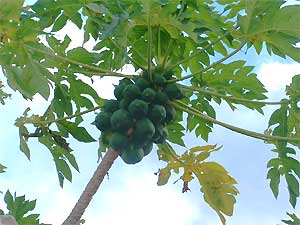
another abundant pawpaw (papaya)
harvest maturing
|
|
Dr Rob Nitchins Response
In the interests of balance we include here the published response by the (then) local AMA [ed: Australian Medical Association] branch president. As usual, the opportunity to investigate a natural, economic and empowering treatment for a common often-life-threatening condition seems to be of little concern compared to promoting the illusion that only medical testing can tell if you are sick! The summary dismissal of Mr Sheldon's documented evidence of his medically-diagnosed condition seems a sad reflection of contemporary health care
[20] [21] .
Several articles in the Bulletin recently have extolled the virtues of a paw-paw “cure for cancer” based on testimonial evidence from a local man several years ago.
I have been quoted commencing favourably, thus implying my support for this type of therapy.
This implication is inaccurate. I do not support such treatment at all.
In my capacity as local AMA branch president, your paper requested my comment about a report from US National Cancer Institute scientists claiming a potentially very potent new anti cancer drug had been derived from papaya (Pawpaw) skins (not from leaves or branches of the tree.)
This report clearly stated the drug was the subject of pre clinical studies. That is, it was yet to be tested on humans. I replied that many anti cancer drugs we now use were derived from plants, so such a report did not surprise me.
I further warned there were many obstacles between discovering agents apparently effective in the test tube or in laboratory animals and finding drugs safe and effective for human cancer.
I was not informed about, nor asked to comment on, your paper's archival material about the man who claimed to have "cured" his cancer by drinking a vile sounding brew made from paw-paw branches and leaves sweetened with molasses.
There is nothing in your reports to convince me the man described ever had cancer in the first place. Cancer is a diagnosis only confirmed by biopsy and microscopic examination, not by xray appearances.
If he never had cancer his "cure" is hardly surprising. I can quote many similar anecdotes about apparent cancer "cure" in patients where no pathologic confirmation was obtained.
I further believe it was inappropriate to describe me in your articles as a local oncologist (cancer specialist) rather than as AMA president.
In my many statements as local AMA president reported in your paper over the last 12 months. I have never been described as a cancer specialist until now. It is ironic and misleading to your readers that it should happen on an issue relevant to cancer.
Patients with cancer are often desperate people who do not deserve to be misled. |
Reader's Response
We are extremely grateful to Racquel, who has personal knowledge of the background details of this story and has given us permission to reproduce her information regarding this article.
I found your article about Paw Paw Leaves interesting. Especially the doctor's claim about Stan Sheldon maybe never having cancer at all.
He did. And he cured it.
While living in Canberra, my Boss, Brian Wolff, who was 48 was diagnosed with small cell carcinoma - lung cancer in april 1993. He was a long-time heavy smoker, smoking about sixty Camel no-filter cigarettes a day. He was given 6-8 months to live and told to put his affairs in order. The tumour was the size of a grapefruit, sitting to the left of his breastbone. A biopsy and all relevant tests were done and chemotherapy offered if he wanted it, though they didn't believe it would change the prognosis.
Sadly, I told my Dad who lives in Perth. He told his bookie (god knows why) who lives in Darwin. The bookie's name was Eric Sheldon, Stan's son. Eric told dad about the paw paw brew and sent Stan's newspaper article and doctors reports to Perth. Dad then sent it to me, I gave it to Brian. Brian was a massive skeptic and didn't believe in any alternative therapies. He didn't believe in doctors either, having hardly ever been ill in his life. As he was reading the newspaper article about Stan's cure something amazing happened. The 'then provider' of pawpaw leaves to residents in states other than Qld, was a Mr Vern Forrest. Vern was a father figure and great friend to Brian in Albury many years before, both owning a racehorse together. I will never forget that moment when Brian read his name aloud exclaiming, "I don't believe it, there can only be one Vern Forrest!"
Brian phoned Vern at Burleigh Heads who recognised his voice immediately and said, "Don't you worry Wolfie, you'll be right in no time," and the circle around Australia was connected. Vern sent us paw paw leaves for some time and we had back up supplies with other friends living there. Brian drank the pawpaw leaf tea for months. 1 glass of 200-250ml three times a day. It tastes disgusting and smells vile. The remedy also called for one spoonful of raw molasses three times a day, but Brian was diabetic so he skipped this bit.
After about 8 weeks during a check up, the doctors were stunned to find the tumour had disappeared. They did more tests to confirm this finding and said "No one recovers from a Small..." (small cell carcinoma) His doctor thought it may have been the chemotherapy which had just started and was skeptical of attributing the miracle to the Pawpaw brew but we expected that. Many months later, Brian chose to have Radiotherapy as well and the radiologists could not find a shadow of the cancer to eradicate. They had to use his original diagnostic tests to pinpoint the target area. He still went ahead with radiation.
Brian lived cancer free and very healthy for another 3� years after which the cancer returned fast and furious. The fight had gone from Brian this time and he surrendered to the cancer which acted swiftly. He passed away over 4 years after original diagnosis of 6-8 months to live. He cherished his last few years as one who is given a new chance at life. He told us about the intense sublime beauty and perfection of the sunset as only one who has glimpsed their own death can. He was a remarkable man and this was a remarkable time in my life. We supplied many people with information and contacts during '93 - '95 who also tried this remedy. Cancer is called the disease of resignation - sometimes this remedy helped, sometimes it didn't.
I just wanted to share my story. I'm on the hunt for more pawpaw leaves now as I found out today a friend has just been diagnosed with lung cancer.
Thanks for reading,
Racquel Andersen
|
PAW PAW Recipe
(as generously provided by Racquel) |
| Why wait for Wholesome Good Health |
|
tincture
|
|
|
First find someone who has access to paw-paw trees that have not been sprayed with pesticides. Brisbane and the Gold Coast has a good supply, you can find them in many backyards. NSW has them too. A couple of sources are recommended so the smaller trees don't get stripped. Australia Post is fine with them being sent by via Express Post satchels.
Racquel's Recipe:
- Cut off the leaves and stems from the tree (not the fruit)
- Wash them with clean water
- Pat Dry
- Roughly chop in pieces 2-3cm
- Fill saucepan with leaves and stems then add water (pressure cooker helps the smell)
- Bring to boil
- Simmer 2 hours
- Strain liquid into a large bottle.
- Discard paw-paw stems and leaves
Drink 1 glass 250ml three times a day. Shake bottle before pouring.
Refrigerate the rest (we used to make 2 litre batches)
- Liquid lasts about 5-7 days before fermenting.
- Leaves last 7-10 days in the fridge before cooking, but are better used fresh.
- It tastes foul
- It stinks
- It looks like green slimy mud
The Aborigines said that paw-paw heals from the inside out. They also said to take 3 big spoonfuls of raw molasses 3 times a day. (maybe it helps with the taste)
You can see more information by clicking on the tabs below
middlepath.com.au> Middle Path> Plants> Papaya ~ Pawpaw cancer cureReferences
|
|


